|
Emergency Contingency Procedures ECP Collision/ Flooding/ Grounding |
Doc No.: ECP 05-04
Revision: 01 Date: 15 Oct 2024 Issued by: DPA Approved by: MD |
5.4. COLLISION / FLOODING / GROUNDING
(a) In a collision of two or more vessels the primary concern is to save human lives on both vessels. The severity of a collision can be quite catastrophic, and the crew should be fully aware of the actions to be taken.
(b) Oil/chemical spills in collisions are of second importance. However, when flammable cargoes are carried, the risk of fire increases with oil/chemical spills. Once both the ships are stabilized, attention must be given to pollution prevention.
(c) Collision may lead to flooding and grounding as well. Hence all these situations have been dealt with, in this section.
(d) VDR data to be saved as per instructions from Company CART
5.4.1. Initial Actions by the Navigational Officer of the Watch
| Stop Engine |
| Activate nearest general emergency alarm - Seven short & one long blast and Call the Master |
| Maneuver ship to minimize effects of collision (if applicable) |
| Announce the emergency word “Collision” or “Flooding” or “Grounding” |
| Turn on all deck lights |
| VHF on channel 16 |
| Have ship’s position available |
| Record the fact in the bell book/memo, as much as possible |
| Announce that personnel should take Positions for Collision Station, ECP-03-00C |
5.4.2. Measures by Master
The following considerations shall be consistent with saving of both ship’s crew and protection of the environment:
(a) Collision
| S.No. | Action | Responsibility | Y/N |
|---|---|---|---|
| 1. | Dispatch an emergency or casualty communication soonest, when assistance or rescue is judged to be necessary according to the extent of damages to the ships involved. | Master / Emergency Communication Officer | |
| 2. | Maneuver the ship so as to minimize the effects of collision | Master | |
| 3. | Take Head Count. | Commander On Scene / Master | |
| 4. | Evacuation of crew from the affected area, if applicable | Master | |
| VDR Data – To be SAVED as per the advice of the company | |||
| Echo sounder provided with feature to save record of history prior to the incident (Grounding/ collision/flooding etc) - such history record to be saved as per Maker’s procedure immediately after the incident to save data. | Master/ Duty Officer | ||
| 5. | Close all water tight doors and other openings. | Flood Control Teams | |
| 6. | If the two vessels are interlocked both vessels may consider the consequences of separating the two. In particular, attention should be given that such separation may: • Cause ignition, • Reduce buoyancy and lead to loss of stability, as a direct consequence of sudden flooding or major change in list & trim, • Cause a larger spill, • Endanger other traffic in area, and • Complicate maneuvering. |
Master | |
| 7. | When there is no serious danger to own ship, stay near to the opponent ship and engage in the rescue of life on other ship | Master/ Flood Control Teams | |
| 8. | Keep own lifeboats ready | Backup Team | |
| 9. | Exchange information on identities (name of the opponent ship & owner, the port of registry and her course quickly) | Master / Emergency Communication Officer | |
| 10. | Ascertain damage to own ship & environment | Commander On Scene | |
| 11. | Condition of bunker tanks and their associated services | ||
| 12. | Notify coastal authorities and update information as soon as it becomes available. | Master / Emergency Communication Officer | |
| 13. | Notify the company and advise for kind of external help required, if possible. | Master / Emergency Communication Officer | |
| 14. | Investigate the complete damage and determine if tanks or hatches have been damaged and whether damage is below or above waterline and chances of flooding. Also, determine whether either vessel has spilled oil/chemical. | Commander On Scene | |
| 15. | In case of damage to tanks causing oil/chemical spill, the following may be considered: • Bring the vessel upwind of the slick, • Shut down intake of non-essential air in tanks, • Isolate penetrated tanks. |
Master & Commander On Scene | |
| 16. | Activate SOPEP/SMPEP/ VRP (in case vessel is in US waters) in case of oil/chemical pollution. | Master | |
| 17. | Prepare for lightering or towage depending on the extent of the damage. | Master, C/E & Commander On Scene | |
| 18. | Keep the damage area and on-going operations in constant observation to ensure stable condition of the ship and keep company informed of the developments, if practical. | Master, C/E & C/O |
(b)Collision (Gas carrier)
| Sr. No. | Action | Responsibility | Y/N |
|---|---|---|---|
| 1 | All crew muster according to the Muster List. | Master | |
| 2 | Stop the Engine. | Master/OOW | |
| 3 | Stop the ventilation and initiate the appropriate emergency shutdowns. | Gas Engg. | |
| 4 | Assess the extent of the damage. | Commander On Scene | |
| 5 | If vessel is in imminent danger of sinking, prepare for abandoning vessel and initiate a Mayday call. | Master | |
| 6 | Alert MRCC, where applicable. Contact Marine/Technical PIC as soon as time permits - if the Master is occupied due to the imminent danger of the vessel then this call must be delegated. | Master / Emergency Communication Officer | |
| 7 | Call for medical assistance if required. | Master / Emergency Communication Officer | |
| 8 | Keep own lifeboats ready | Backup Team | |
| Are vessels dead in the water and interlocked? | |||
| 9 | Initiate a dialogue with the other Master whether to separate or not taking into consideration: pollution, fire, stability and any potential to escalate the situation. | Master | |
| If vessels are not interlocked. | |||
| 10 | Manoeuvre the vessel to minimize the effect of the collision. | Master | |
| 11 | Aid the other vessel if possible. | Master | |
| 12 | Prepare initial casualty report to the Company. | Master / Emergency Communication Officer | |
| 13 | If the vessel is on fire, leaking oil, leaking cargo and/or vapor, proceed according to the emergency procedures for same. | Master / Commander On Scene / Emergency Teams. | |
| 14 | In case of a cargo leakage or pollution consult SOPEP checklist. | ||
| 15 | Assess condition of cargo tanks, pipelines and containment (Hold space). Checks for any leakage. | ||
| 16 | Broadcast distress alerts / messages, if the ship is in grave and imminent danger and immediate assistance is required, otherwise broadcast an urgency message, navigational warnings to ships in the area. | Master / Emergency Communication Officer | |
| 17 | If in coastal waters contact Local / Port Authorities. | Master / Emergency Communication Officer | |
| 18 | Where the vessel is enrolled, prepare a Ship Emergency Report (SERS) to Class or the body responsible. | Master / Emergency Communication Officer | |
| 19 | Muster all personal and advise the Bridge. | Commander On Scene | |
| 20 | Establish communication between all parties involved. | Master | |
| 21 | Prepare an "assessment team" for inspection, team to be outfitted as situation requires. | Master/ Commander On Scene. | |
| 22 | Assess the extent of damage and report to the bridge. | Commander On Scene | |
| 23 | Are any tanks / compartments damaged above or below the water line? | Commander On Scene | |
| 24 | Sound Tanks - Stability Calculations - Monitor changes. | Flood Control team | |
| 25 | Make a print of Loadicator as it was prior to the collision and monitor any changes. | Gas Engr | |
| 26 | Prepare for Emergency Towing if necessary/fitted. | Master / Commander On Scene / Emergency Teams. | |
| 27 | Monitor the gas detection system. | Gas Engr | |
| 28 | Monitor tank levels and pressures. | Gas Engr | |
| 29 | Ensure regular updates to the bridge. | Commander On Scene | |
| 30 | Initiate check of integrity in the engine room. | C/E | |
| 31 | Engine room to stand-by, and engine made ready for immediate maneuvering. | C/E | |
| 32 | Support services as situation dictates. | C/E / E/RM Team. | |
| 33 | Condition of bunker tanks and their associated services | ||
| 34 | Check and maintain ventilation as appropriate. | E/RM Team. | |
| 35 | Ensure sufficient generators running. | C/E / E/RM Team | |
| 36 | Monitor machinery and be ready for damage control support. | C/E / E/RM Team |
(c)Additionally, for Grounding / Flooding / Stranding For All Ships
| Sr. No. | Action | Responsibility | Y/N |
|---|---|---|---|
| 1 | In case of imminent danger of sinking due to flooding, beaching (5.1.5) should be considered if possible. | Master | |
| 2 | Steering System to be switched off on Grounding | OOW | |
| 3 | Display Lights/ Shapes for vessel Aground. | OOW | |
| 4 | Advise Local Agent | Master | |
| 5 | Assess ballast tank and their adjacent lines. | Commander On Scene | |
| 6 | Sound all tanks. | Commander On Scene | |
| 7 | Check over side soundings | Commander On Scene | |
| 8 | Condition of ship - stress/torsion | C/O | |
| 9 | Tide range, current fluctuation | 2nd Officer | |
| 10 | Present and forecasted weather conditions. | 2nd Officer | |
| 11 | Bottom characteristics of the sea bed | 2nd Officer | |
| 12 | Monitor pumps and other running machinery. | C/E | |
| 13 | Check intakes are clear, switch to high suction. | C/E |
(d) Additional Measures in a Port / Harbour.
- Inform Port Authority and local agent
- Inform harbour fire brigade (if required)
- Keep international shore connection ready, if required
- Maintain head count of crew and Supernumeraries/guests
- Inform Port Authority about hazardous dangerous goods, if applicable
5.4.3. Important Factors to Consider
(a) In Case of Collision
If the two vessels are interlocked, both vessels may consider the consequences of separating the two. In particular, attention should be given that such separation may:
- Cause ignition
- Reduce buoyancy and lead to loss of stability, as a direct consequence of sudden flooding or major change in list & trim
- Cause a larger spill
- Vapour emission, which may lead to a flammable atmosphere
- Wearing BA set and checking atmospheres, both at the site of Impact and inside the Accommodation / E/RM
- Endanger other traffic in area
- Complicate maneuvering
(b) Grounding/ Flooding
Prior to taking any actions to re-float the vessel, the following aspects should be considered:
- Advantage versus risk in immediate re-floating attempt
- Is the vessel likely to re-float, if so; would that be advantageous? Would the vessel then drift to a more perilous position?
- Potential aspects of sea condition
- Potential of increase in pollution
- Condition of ship - stress/torsion
- Tide range, current fluctuation
- Present and forecasted weather conditions
- Bottom characteristics of the seabed
- Liaise with the Local Port / Agent / CART / SERS / P&I / Charterer / PIC
Note: Before taking any action for re-floating the vessel, the master should contact the company and seek professional assistance like salvage, towing, etc.
5.4.4. Damage Control
(a) If the pumping capacity of the ship is larger than the volume of ingress of water, it is considered that there is no danger of sinking. However, as the flooding may cause change in vessel stability conditions, there exists a danger of capsizing.
(b) It is essential to measure the volume/weight of ingress of water by checking soundings of tanks, holds, or bilges. Special attention to be paid to the change of the ship’s trim and draft.
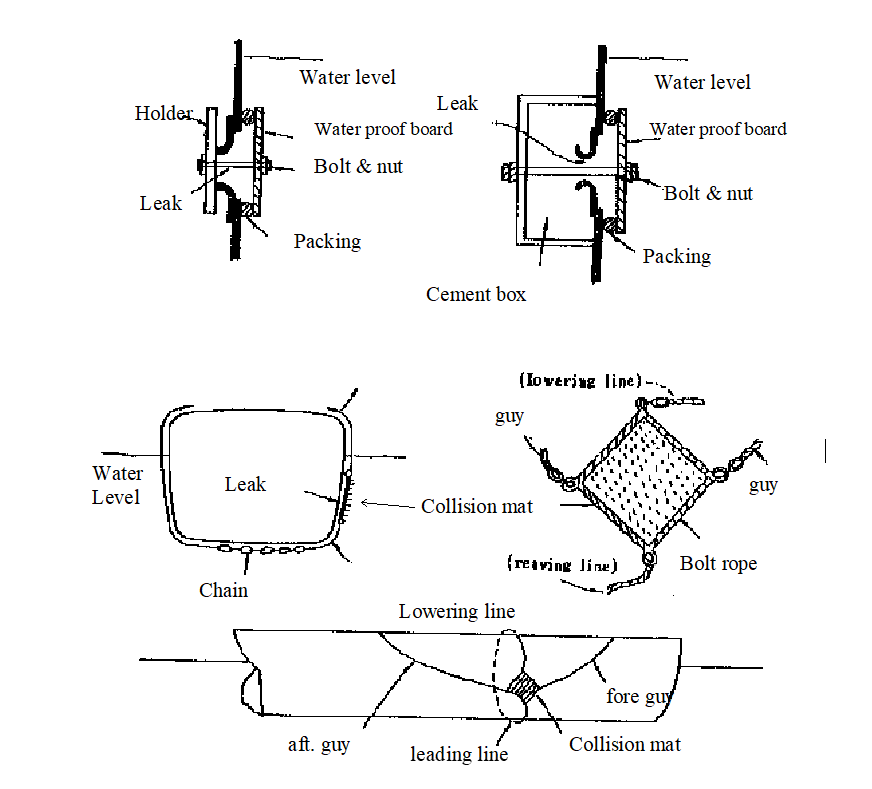
(c) Depending upon the size and location of damage (hole or opening on hull), the following may be considered to control the flooding:
- In case the damage/hole is small and located at a place having water pressure, some cloths or mats over the hole may be placed from outside the ship. Due to outside water pressure, they shall be sucked in and block the flow of water from outside.
- Similarly, for a small hole at an accessible place, a cement box can be made to stop or reduce flooding.
- Waterproof board is placed on the ruptured area of the hull. It is fixed by bolts.
- Underwater welding is a method where steel plates are welded from outside the ship in the water and therefore is useful for a larger area.
(d) In case of any damage or suspicion of damage, consider lodging a note of protest with the harbor master in the next port.
Methods c) and d) may require professional help. Refer to attached sketch.
5.4.5. External Assistance to Tankers
Tankers should activate Emergency Technical Assistance Service, a 24-hour help provided by the Class as per agreement of the company.
5.4.6. Record Keeping
The master must ensure that details of all events and actions taken are recorded as accurately as possible.